IoT: Pacemaker Helped Police To Accuse Someone With Arson

The story was in the press earlier, but I have to admit that I heard it at the Gartner Data & Analytics Summit in Frankfurt for the first time this year.

In this case the police called pacemaker data an ‘excellent investigative tool’ that provided ‘key pieces of evidence’ to charge a man with arson and insurance fraud.The data collected from his “device/ thing” (heart rate, pacer demand and cardiac rhythms) before, during and after the fire, clearly proved that he was not in panic.

This story is just one of many in the world which will be massively impacted by the IoT (Internet of Things). Numbers of connected devices are growing by orders of magnitude. Every business will use data from outside.

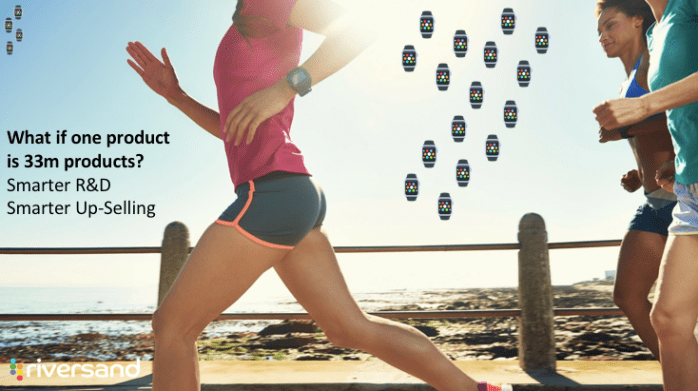
You may thing the apple watch on the apple web shop is only two sized and about ten different arm bands and in the meantime three generation which is about 60 different product SKUs to manage. So why should I need a MDM solution to manage this? Well, the press says the watch was sold more then 33 million times, which massively changes the game about data. 33 million different data sets and profiles (for example: I am a runner and my neigbour does not do any sport but has the same watch), which can be used to improve product development or cross- and up-sell potential. Think about what this means for your business.

Screen Shot 2018-04-12 at 08.15.35.png

It is time to master things!

In my next blog I will go deeper on the success criteria for the MDM (Master Data Management) of Things. And this is much more than mastering products. It will be about massive scale and connectivity and all humans expect relevant data for decision making as employees or customers in real-time.

Debunking Three Myths of The Gartner MDM Magic Quadrant

The new 2017 Gartner Magic Quadrant for MDM solutions is out and available for download here.

An analyst once compared the Magic Quadrant with sports. At a conference he said: “Being an analyst in the MQ is like being a referee in kids soccer. Before the game everybody wants to be your friend. By half time almost everybody hates you.” What he described was the relationship between analysts and software vendors with a wink 😉 … and all people were laughing in the audience.

After ten years being involved in different magic quadrant processes, I thought it is time talk about a few things which have not been in the news. I love to debunk three myths about the MQs.

Myth 1: Money makes the MQ go round

Many people live under the impression that vendors which pay the biggest checks to Gartner will jump on the MQ. This is sooo wrong. Gartner strictly separates any financial flow from this market evaluation. The process and the integrity of great analysts like Bill O’Kane, Simon Walker, Michael Moran in this case (and Andrew White in the past), who put a lot serious work into this process to paint a realistic and neutral picture of the market with looking at of the period of 2016 and Q1-2017.

Myth 2: Large vendors dominate

Disruption is more than a hype in these days, it is reality. Gone are the times where the so called mega vendors (SAP, IBM, Oracle) where the only dominators. My old company Informatica grew, based on two great solutions (Siperian customer MDM and Heiler PIM) to a new leader. I am thankful for ten years being part of it. Now many new start-ups and concepts have started to challenge this status quo again and again. New technologies have offered new and fast ways to address challenges where the industry thought it takes years. This is wrong. New ways and new tech have changed the MDM market as never before. Time for new things.

Myth 3: A picture paints a thousand words

Be honest, the first thing you look for is the chart. Who is where? What has changed? Yes it helps to get a first glance, but it is wrong to only consider the MQ chart. As mentioned above, a lot work goes into it from analysts, all customer and all vendors – so they all deserve to take a deeper look on strengths and cautions and reading between the lines.

Finally

There was enough said on the new market perspective Gartner defined with the 2016 release. Nothing is more constant than change, so also the MDM vendors have to revisit their strategy and offering regarding news technologies such as AI and big data, but first of all customer expectations.

If you are about to use the MQ as starting point for the vendor selection, my recommendation is: Let future readiness and vision be your factor. You will pick a solution which you will impact your business over the next decade. You don’t want to pick a solution which has home work to do cleaning up old heritage.

PS: I am a true believer in close collaboration with the analysts and learned incredibly much from many smart people of the years in this market.

The new 2017 Gartner Magic Quadrant for MDM solutions is out and available for download here.

Conversational Commerce: Two Third of Requests are about Products & Service

I had the great pleasure working with Smoope, a messaging as a service vendor recently. The segment is super relevant in these days selling to millennials. In these days every smart company is trying to find their strategy for turning conversations into transactions.

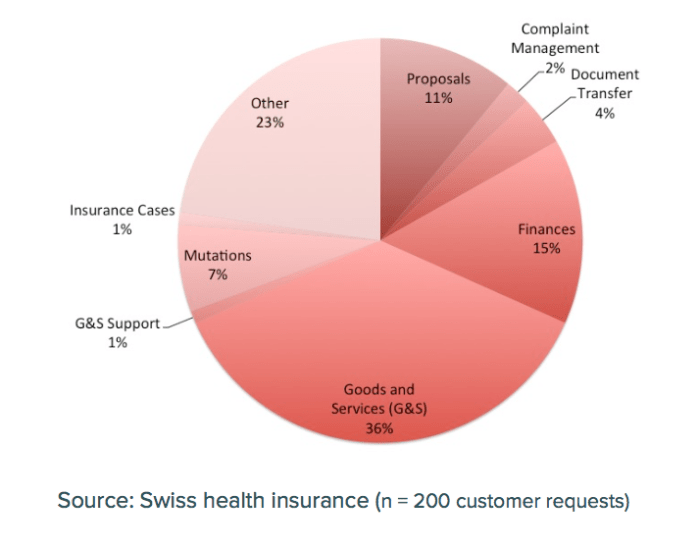
What I learned from a research in an analyst conversation with Lefti Co-Founder of Smoope and Forrester Analyst Laura Naparstek was, that 36% of conversations in chats are centered around “products & services”.  That emphasizes the need for rich and fast product master data to power the conversational commerce channel with the right and relevant data so that the customer can take a purchasing decision.

Bildschirmfoto 2017-10-25 um 15.33.20

I my opinion the omnichannel term continues to expand adding new interaction channels, such as messaging. This brings the need to integrate data and connect master data to new apps like messaging platforms. Clearly this is tied to the AI and chatbot discussion and blog, I published this summer. Wether you are talking to a human being or the AI-driven bot, answers can only be as good as the data foundation to offer the right product at the right moment. This promise and challenge, has just become more complex.

There is an appetite talking to brands through messaging, but the brands need to be clear on expectation setting and their processes. Many brands seem not to do well and are not able to go beyond the welcome message. Many are not set for taking the conversation to the next level and advancing the conversation, which will turn customers away easily.

The future vision in this segment is clearly impacted by the Zeitgeist of Alexa and Siri where customers are getting used to the most simplest way of formulating their need. Like texting or saying “please transfer 20 Euro to Ben”, or “please send me the shirt which was delivered today in size M” without filling out a complex form.

The New Live Soccer Experience or The Bitter Truth of German Internet

soccer_pub_digital001

Germany is a highly developed economy which is not shy of any international benchmark. In times of the digital transformation discussion, politicians frequently address one of the foundations of making digital business and digital work place models a success: fast broadband internet. Yes, my friends in the US, we have a challenge here.

Germany’s soccer fans are unhappy this season with Sky who does not offer any more all Bundesliga games, while prices for their subscription have not changed. Clients have to sign up for the Amazon/ Eurosport channel to see the Friday games.

Last Friday I went to a local bar/ pub to watch the game of VfB Stuttgart with friends and many local supporters and had a real new live soccer experience:

The first five minutes the large plasma TV was all but not HD. Reality was it was unsharp lagging and stuttering. While discussing the first scenes and missed chances over a beer, I noticed vibrations in my pocket. It was my phone obviously alerting me that VfB Stuttgart leads 1:0. But the entire bar was still seeing the 0:0 score.

So I said to my friends “I bet player x has missed some chances, but he will score a goal today” with a bright smile on my face 😉  From this moment on a new pattern got established in the bar. People started to follow the game on live tickers and Twitter using their mobile phones to be right faster.

Everytime a critical alert came in people stopped their conversations, put their phones and came closer the the TV screen to see what will happen – or better “has” happened.

For all fans of live sport events, this is clearly a momentum, where watching sports in the internet is getting less attractive. In our case the bar owner was said because their guests have been unhappy about this. The bitter truth is, it is not their fault. They would go for a high speed internet deal, but is is just not available. I would go for it to, but it is not available.

How can the future of a connected home, working from home and all IoT connected devices work, if there is no fast internet? 

Conversational Commerce: Chat Bot vs Human Being

You may know from my blog, that I like to challenge brands and companies on their customer experience and understand how much they are using latest tech solution to enable a data-driven business in order to sell more or service better. As a fashionista I signed up for Zalon, a service by German fashion giant Zalando. They claim to jointly create my new outfit on their front page.

This is my summary of my experience after using for about two weeks: The first thing you do is selecting your preferences across all categories of clothes. For example if you are only looking for business or also for casual wear, of which kind of shirts you like (button down or kent, stripes or plain etc.)

You also are asked to add your size and you can submit pics of yourself, so that your personal shopping assistant will be able to better understand your style but also your body shape.

I decided to provide as much information as possible (also that I blog about fashion), hoping it will help to tailor the offerings to my need.

The pros of this service are:

  • They show customer orientation by offering it
  • It feels like responses are faster compared to email
  • you feel special having a personal shopping assistant

The cons after two weeks testing it:

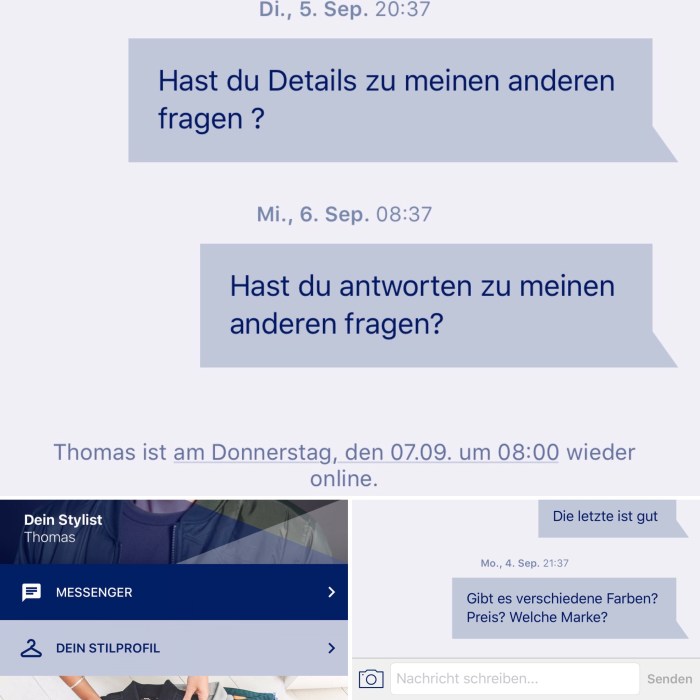
  • I clearly told my sizes, but other sized have been offered (I am pretty tall)
  • The app says “Thomas” will be online again in 1 hour, but this gets postponed three times in a row
  • I asked questions and did not get answers on brand and price

IMG_0751

What role does AI and Customer 360 play?

Some questions I have are: Is the Zalon sharing my profile data with Zalando and Zalando Lounge to better understand my preferences and shopping history to predict my next action? How advanced are they on leveraging the potential of “Customer 360” including my social interactions.

Who is able to deliver more value with todays technology? A chatbot like Levi’s or a real person from Zalon? (You may also check what Suitsupply is doing using WhatsApp.) I checked the Levi’s bot and obviously it delivers all answers right away like my 505c I was not finding in stores, but I was limited showing the used style I wanted.

Clearly omnichannel customer engagement has found one important new trend and channel, called “conversational commerce”, where vendors like Smoope or Twilio are playing. An important questions will be how serious WhattsApp owner Facebook will be going after this B2B market opportunity. (Read more here.)

Challenging Peek & Cloppenburg Omnichannel Experience 

If you are in charge of customer experience and revenue this is a relevant story for you, no matter if you work in retail or any other industry.

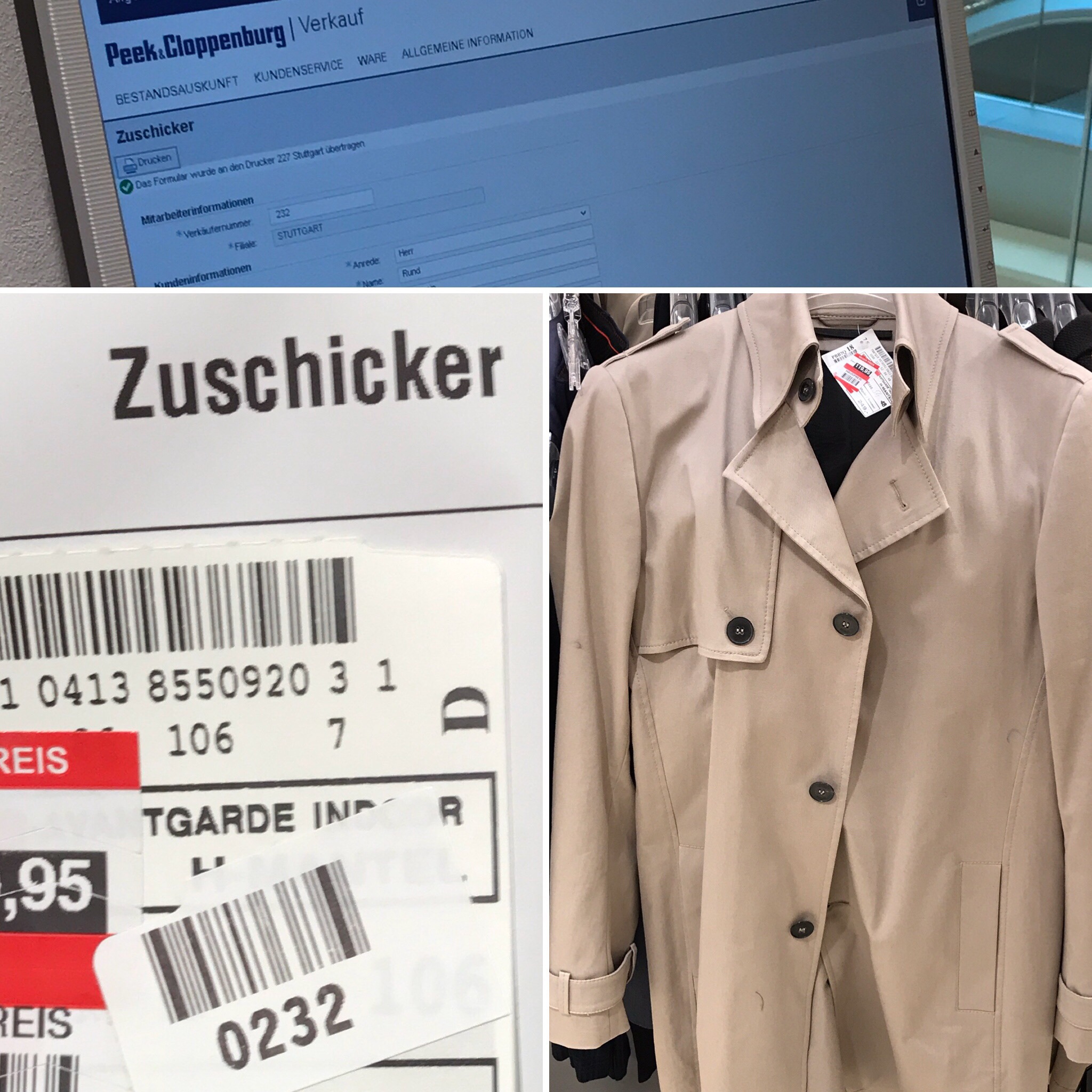
I walked into Peek & Cloppenburg in Stuttgart city just for browsing. As I found a highly discounted trench coat I asked, if I can get this shipped home because I was about to go out and did not want to carry a bag.

I was excited because the answer was yes. But the store assistant said it will take ten days. 10! 

Me: Ten days, really? 

In-Store assistant: yes, we send it to our central warehouse and from there to use. All paperworks and logistics take ten days.

Me: really? It is a 30 min drive to my house? The customer will not accept this in the near future.

In-Store assistant: I will inform the management about your feedback, but it would be better if you tell them.

Me: No prob, I will blog about it. 😜

The process of getting me registered was entering my address from scratch. I asked “do you want my email address or loyalty number?” “No we cannot do this here.”

I wonde if I get my loyalty rewards?

They told me to go down to the cashier and pay in store, so I did.

There came the next surprise: the staff down there told me the home delivery is not possible….

I decided to abandon this transaction. 

The Ultimate BBQ Grill: How Artificial Intelligence Shapes Customer Expectations

Has BBQ season already begun where you live? It has for me. In fact, I got the idea for this blog while having a get-together with friends over the weekend. This time, my friend Stefan was in charge of grilling burgers for a total of six guests. As he was cooking, I began to think about what requirements matter important to me when selecting a BBQ grill. I realized I have an ultimate list of requirements for a BBQ grill, so I thought I’d share it here:

My Ultimate Requirements List for a BBQ Grill

  1. Power: Gas, charcoal, pellet or electric (this discussion can get heated)
  2. Type: Would  you prefer direct or/and indirect
  3. What you plan to grill: Fish, meat, vegetables
  4. Speed: Do you like fast and convenient or slow and celebratory?
  5. Accessories: Plethora of them (about 15 accessories for 2017)
  6. Cost: Expensive or budget friendly
  7. Space and Size: Select depending on the available

What do you think of my list? Did I miss anything you consider crucial? If so, let me know and I will gladly update my list.

Artificial Intelligence Shapes BBQ Grill Expectations

As I thought about the list, I realized that both data and machine learning change customer expectations, in particular when selecting household items like BBQ grills.

How? Let me talk about laundry and washing machines first. I am not kidding. Listening to Electrolux during the Informatica World Tour in Stockholm, I learned that they are using data to help each house find the right washing machine for their household need. In order to do so, in-store staff or configurators on the web, asked questions like: How many people live in your household? How many adults, how many kids? What fashion do you wear? What sports do you play?

Another example from JLL is a professional services and investment management firm offering specialized real estate services to clients seeking increased value by owning, occupying and investing in real estate. “Data is the fuel of our organization and our differentiator in the marketplace. Empowering clients, building managers, and revenue-producing partners to paint a picture or tell a story with information has been the biggest and most important change Informatica has helped us make”, said Mike Hart, Director, Research- VP, Data Management & Operations, JLL Inc.

You must be wondering, what does this have to do with your BBQ grill? Would it help if you would know things like,”this grill fits 6 steaks, 4 hotdogs and 8 burgers at once”, instead of reading it on a website “the primary cooking surface measures 25.6-inches wide by 18.5-inches deep”. Which information helps find what you require for your family and friends?

Ultimate_BBQ_Grill_Checklist

The story behind the scenes

You may wonder and question how this works. The story of the washing machines shows that enterprises can match buyer persona with products for better targeting and better service. Transforming a grill surface measurement into the average sizes of burgers, steaks and sausages can be automated by machine learning and automated data processes in the context of master data management, called MDM.

In today’s world brands, manufacturers and retailers manage attributes of the products and services like size, speed or similar attributes. Today, enterprises standardize their data to make sure you are able to see only in-stock items, for example see all red polo jerseys when activating the red color filter. In future, this will be augmented by transforming these values into a more customer friendly message making life easier for the client, which turns into better conversion and customer loyalty.

And there will be more use cases of how AI can lift up the product categorization for omnichannel commerce, but I will tackle this in future blogs.

The New Customer Engagement: Social, Individual, Fast

I know, it is not usual to promote a certain brand on a blog like this. But I have to share this customer experience with Suitsupply. It is my favorite brand for suits, shoes and accessories, I wear for business or events like weddings.

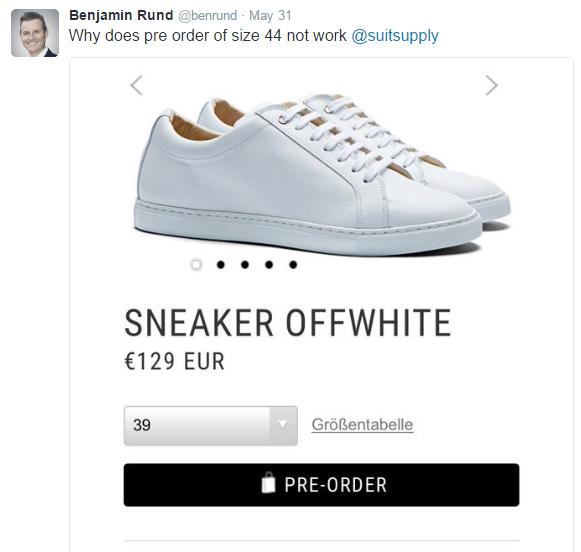
First of all it started off with an issue. I was trying to order shoes in 44.5 (EU size). The web shop showed that this size was not available right now, but I can create an alert, when it is available. I decided to do this. I guess you are not surprised that I was doing this with my smartphone. Sadly it turned out that this function was not working properly, it was only allowing me to select the alert for EU size 39. So I decided to tweet about it.

suitsupply0

With that, my customer experience journey started. They immediately send me a  direct Twitter message. They have been able to identify me and my customer profile, from knowing my twitter name @benrund and immediately matching it to my full profile and email address below.

suitsupply_1-1

But this was not it. They have proven to be fast and agile and made it easy for me to spend my money. A direct link led me to the shopping cart, where I just had to do the transaction. Done. A few minutes later the next twitter message was in.

suitsupply2

Yes, these  shopping the style service are not new. But I tended not to use them because I have fun on creating my own style and outfit. Selling an outfit requires to build a bundle of products like, shoes + belt + pants + shirt. Brands and retailers are doing this with PIM apps for merchandisers and marketers. They can easily group products together into a bundle, which is promoted in a certain campaign. Sounds obvious but, reality still shows a lot companies have not solved this challenge.

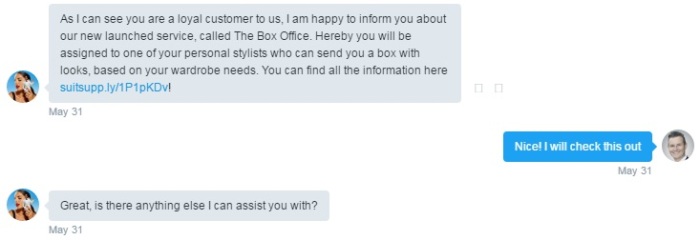
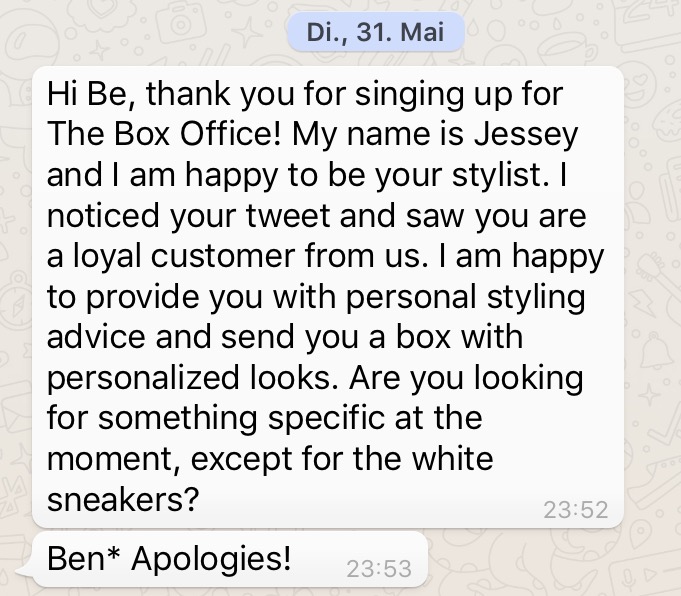
This time I decided to test it, as they showed real service and focus on me as a client. I signed up for the Box Office. But did have to work, so I did not continue filling out my preferences. Just after few hours, later at night, it was 11 pm I was contacted via WhatsApp. This means they know my cell phone number, and I gave them permission to use it.

suitsupply3

Via WhatsApp, which was very easy for me, I sent over my preferences in an unstructured way. For the result, I did not have to wait long, a mid size box, but with tons of things in it, was shipped. See my pics.

IMG_3364-768x576

I am definitely keeping some items, not all. But all the selected sizes are perfect, they fit! And you have to know I am somewhat tall 😉 They really have shown what Customer 360 means.

PS: What happens if I ask them to show me my full customer profile? With the GDRP Individuals will have more information on how their data is processed and this information should be available in a clear and understandable way. Data protection authorities will be able to fine companies who do not comply with EU rules up to 4% of their global annual revenue. This is relevant to all companies who serve EU citizens.

PPS: While I was impressed by the simple experience of WhattsAppp, companies like Twilio and Smoope (even from my hometown Stuttgart), try to take messaging as a service to the next level for holistic, end-to-end omnichannel customer engagement strategy.

Shopping Guide Siena (South Toskana)

Everyone talks about Florence, but Siena is one of the pearls of the Toskana. You can easily combine sight seeing with shopping all in walking distance. If your are a fashionista check out these stores in Siena. The city is situated up in the hills, so park your car at the train station or the parking lot called San Francesco and use the five escalators to reach the city. 

I suggest you go on a Wednesday and combine the weekly market between 8-13h (Via La Lizza) with city shopping in the afternoon. But plan a break for a coffee or Spritz at Caffe del Corso and have a bite at the market.

The weekly “Mercado” is pretty large for such a small city and comes with all you need. Fresh fruits and vegetables, burrata, or a snack on the go. 

Regarding fashion you may find some very exclusive picks or dresses starting from 5€. With the right eye for style ladies can find a special dress with Italian style for low budget.

If you are more into real stores, here are some names you should check out in google maps when planning your trip.

Ginger, Aloe & Wolf, Mag, Franchi (Moschino and more), Dolci, Dixie (for her) and right across Sartorio Rossi suits for him.

Let me close with a few pics of looks and pieces I liked this summer.


As a result my wife got some real good discount on Moschino things and I found the most craziest shoes I had so far. And finally “grazie mille” at my friend Fabio for showing us Siena. 

Shopping Guide Berlin For Her and Him

Berlin. August. 31 degrees. But in fashion the next season is always close. 

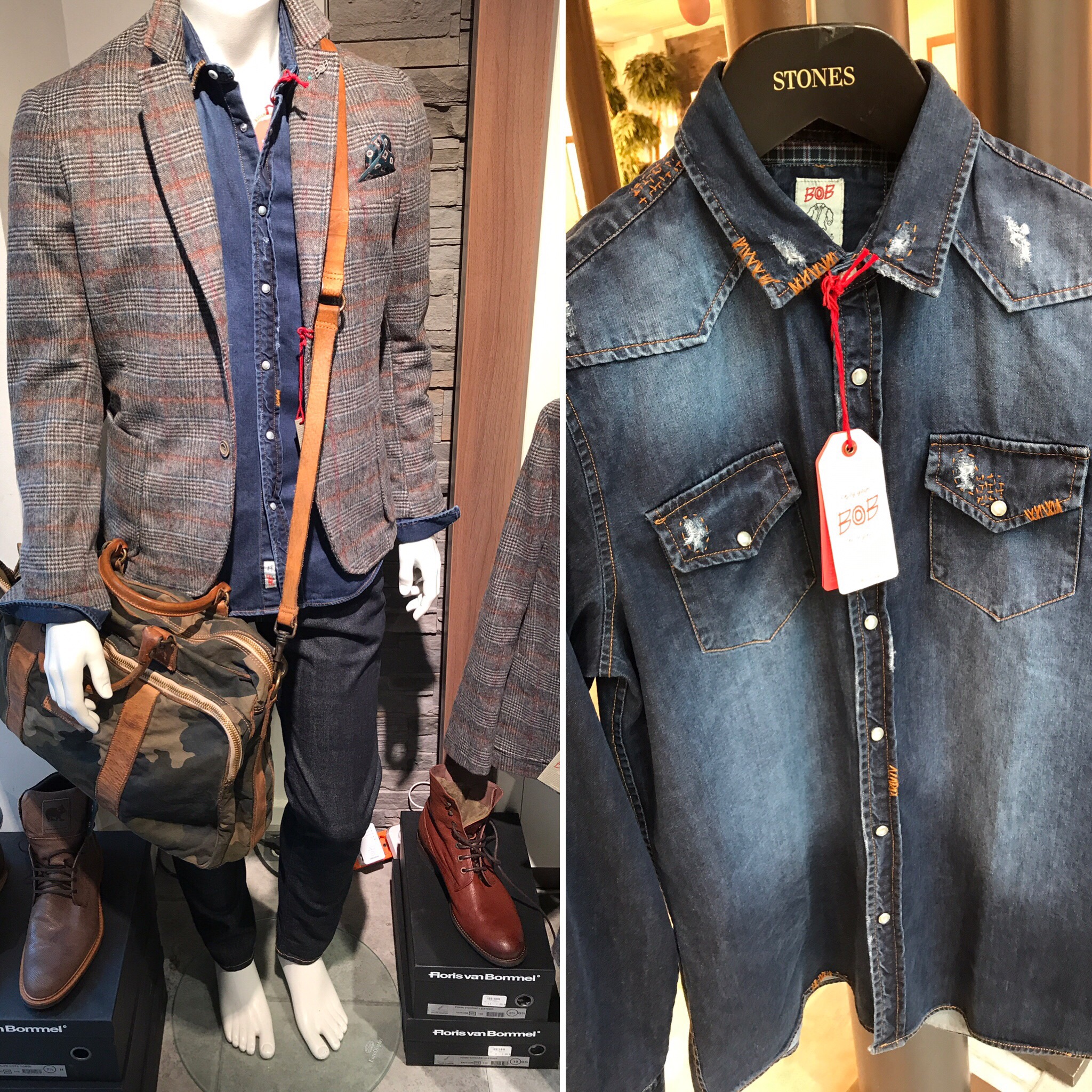
If you travel Berlin, avoid Kurfürstendamm. A roof top Glas of champagne at KaDeWe is never a wrong thing, but please go to places with more flair. Here is a casual business look I found, close to the Berlin Internet Start Up in a store at Hackesche Höfe.

A sakko like this you may already have in your closet (I hope so), but combine it with used jeans shirt like this piece from Bob, a camouflage bag, dark pocket square and brown Floris van Bommel boots.

Also check out http://www.14oz.com, who runs a outlet store close to their main store. Personalize your snap back from New Era in their small flagship store and look a real hard working man with boots and jeans from Burg & Schild

For her: Princess goes Hollywood, Rosenthaler Str., has super picks, your friends will be jealous about…. Kashmir!

If you go shopping there, close your day with a drink in one of the trendy bars, like Cordobar, Revolver Burger or one of many other nice places around Hackescher Markt.

Is Householding is a must do for B2C Marketers?

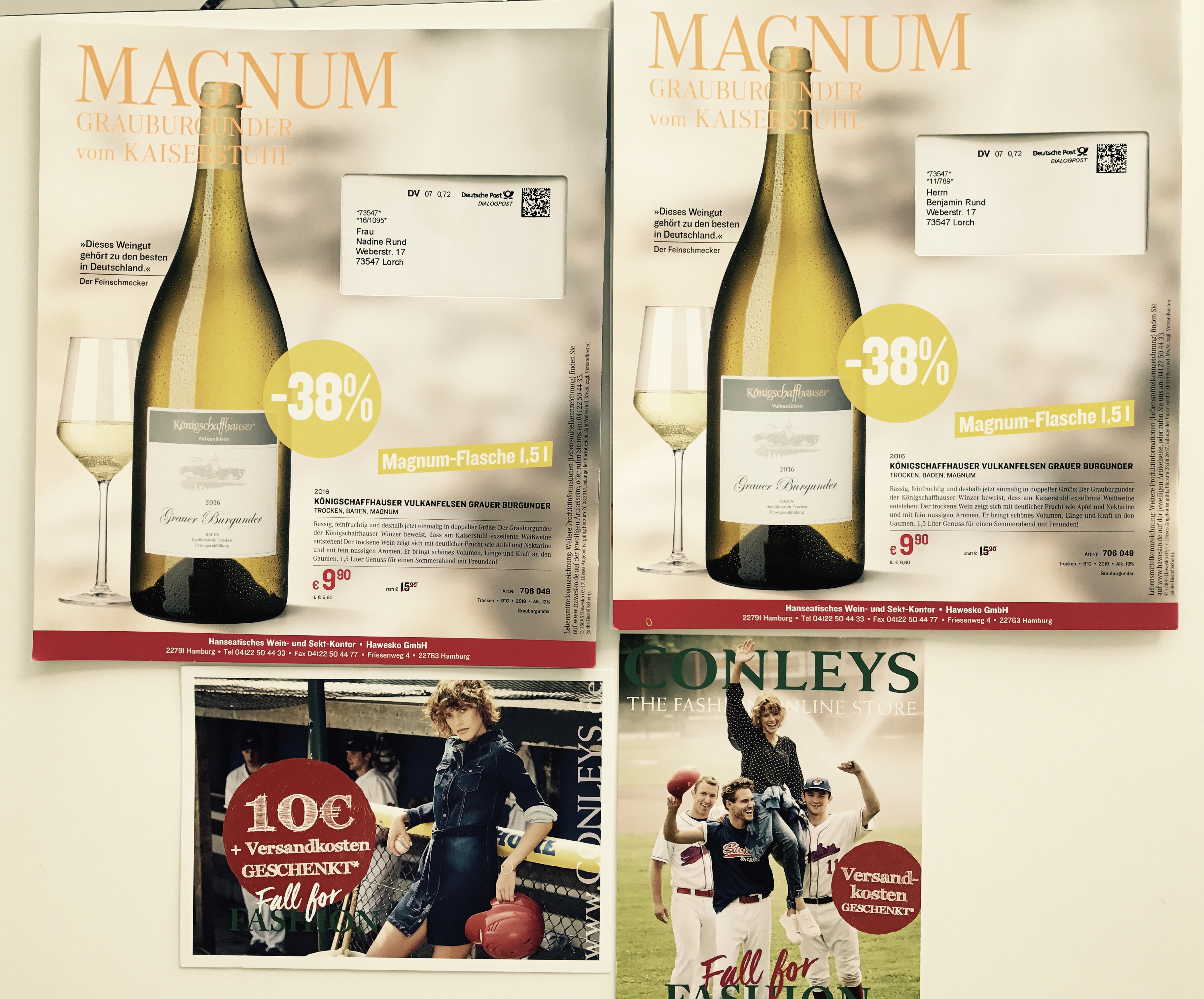
Yesterday I found these four pieces in my mailbox and felt it is time to write about it. 


The wine retailer is sending the same brochure of Sommer wines to my wife and me. Was not necessary? Could they save print and shipping costs? Not a big issue for me, but more for the enterprise – imagine they do this for 10s or 100s of million of customers.

The fashion retailer as started with a nice idea, by tailoring the campaign image to the gender. Both images are part of the same campaign theme, while she got a woman and I got the men’s card. Nice start, but the I als myself:

Why does my wife get a 10€ voucher and I am not?

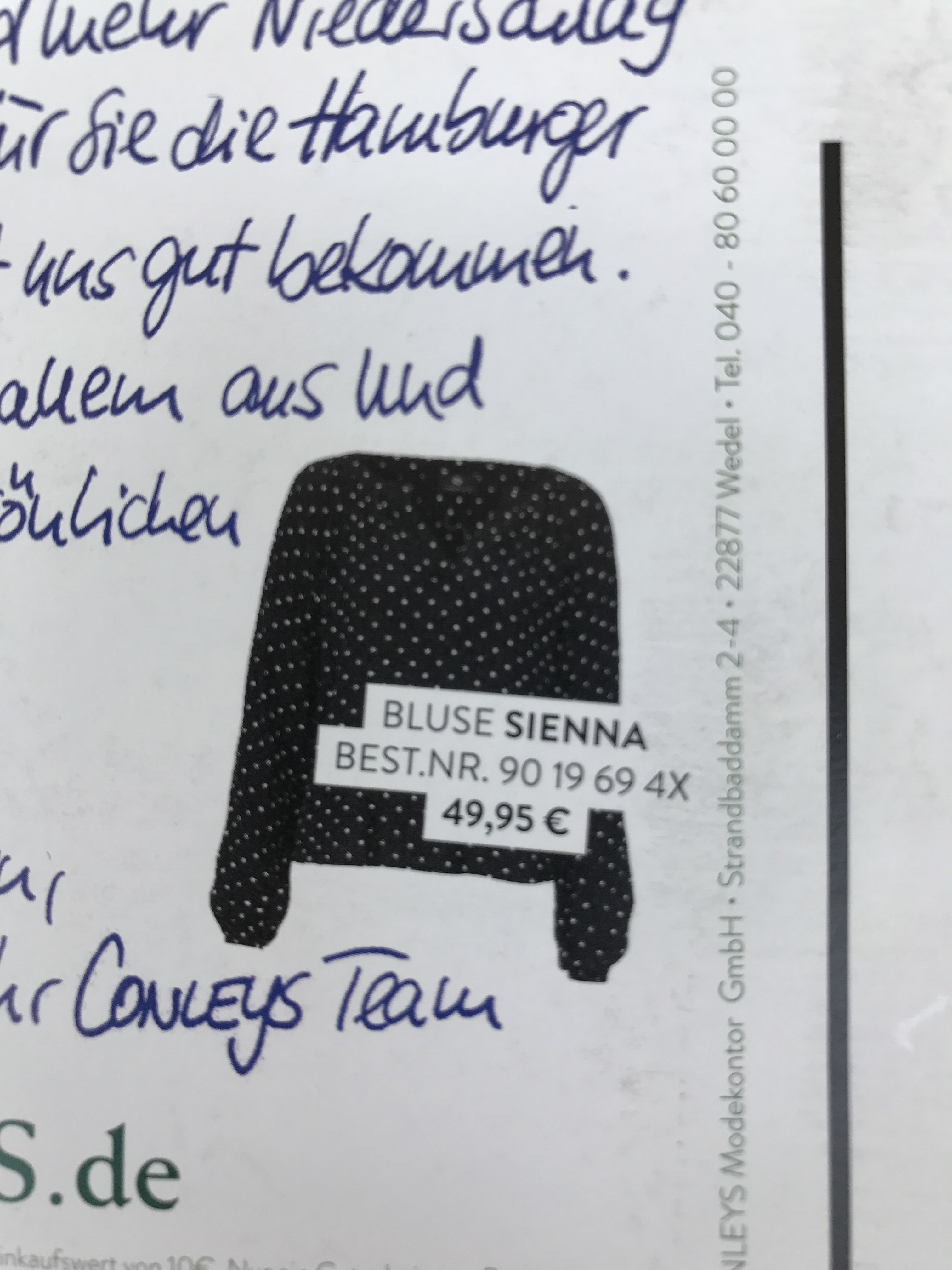
Why doe the backside of my post card show a female dress?


Depending on where you live, you may have a different opinion if print mailings and catalogs still are state of the art and can drive online transactions.

But finally householding can be the secret source to more marketing efficiency and intelligent cross selling. Connecting the dots across data like people, places and things is a prerequisite to understand that my wife and I live at the same address. Sounds obvious, right?